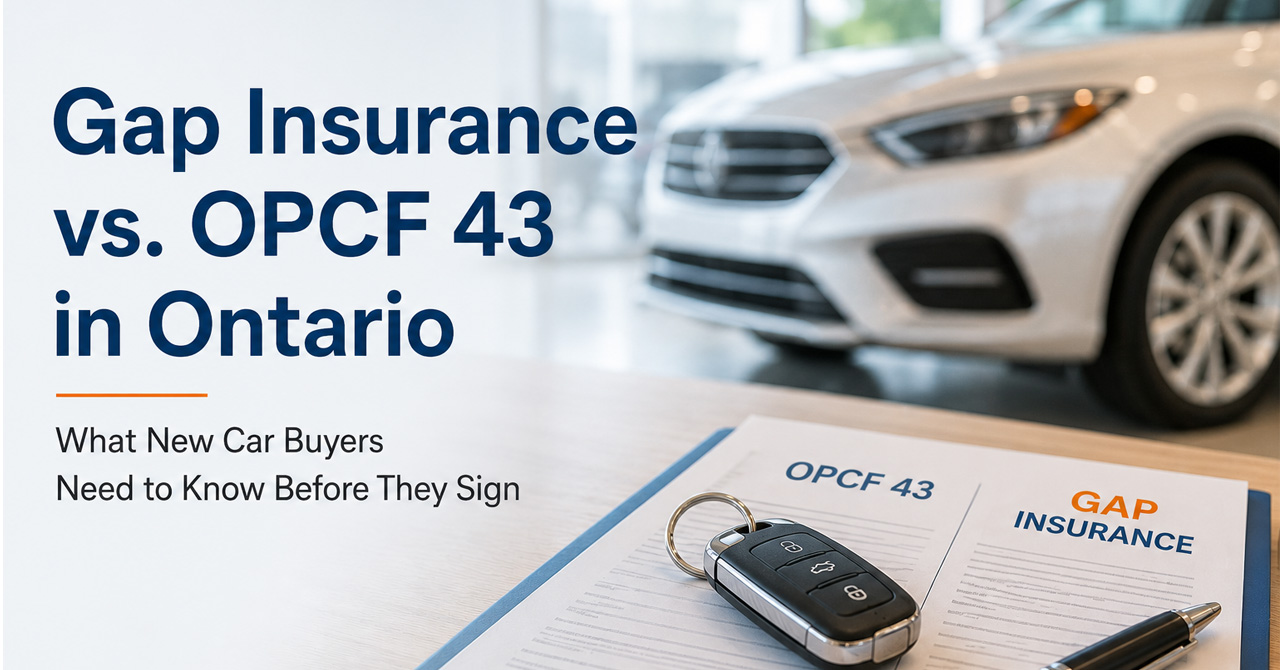
Gap Insurance vs. OPCF 43 in Ontario: What New Car Buyers Need to Know Before They Sign
July 14, 2026
Share:
Most people don't discover the real cost of vehicle depreciation when they buy the car. They discover it after the car is stolen, written off, or declared a total loss — and by then, the paperwork has already decided the outcome.
That is why it pays to understand the difference between OPCF 43 and gap insurance before you finalize your next vehicle purchase, lease, or finance agreement. They sound similar, they are both connected to depreciation, and both may matter if your vehicle is declared a total loss — but they are not the same thing.
Here is the simplest way to think about it:
OPCF 43 helps protect the value of your new vehicle. Gap insurance helps protect the balance of your loan or lease.
Quick Answer: Is OPCF 43 the Same as Gap Insurance?
No. OPCF 43 and gap insurance are different forms of protection.
OPCF 43 , also known as a waiver of depreciation endorsement, is added to an Ontario auto insurance policy. It can help prevent depreciation from being deducted from your settlement if an eligible new vehicle is declared a total loss.
Gap insurance , also known as Guaranteed Asset Protection, is designed to help cover the difference between your insurer's total-loss payout and the amount you still owe on your vehicle loan or lease.
One focuses on the vehicle's value . The other focuses on the debt attached to the vehicle . When you are buying, financing, or leasing a new vehicle, that distinction can make a major financial difference.
Why This Matters for Ontario Drivers
Buying a vehicle is no longer simple. The price of new vehicles has climbed, loan terms are often longer, and leasing and financing structures can be complex. Many drivers are making smaller down payments or stretching payments over more years to keep monthly costs manageable, and that creates a risk: your vehicle may depreciate faster than your loan balance declines.
So if the vehicle is written off, your insurance settlement may not line up with what you paid, what it costs to replace the vehicle, or what you still owe. That is where people get caught. They think they have "full coverage." They think their new vehicle is fully protected. They think the dealership, the lender, and the insurance policy are all solving the same problem. Often, they are not.
This is why understanding OPCF 43 versus gap insurance is not just an insurance detail. It is a financial protection conversation.
What Is OPCF 43?
OPCF 43 is an optional Ontario auto insurance endorsement that removes the insurer's right to deduct depreciation from the value of an eligible new vehicle after a total loss.
In plain English: if your new vehicle is stolen and not recovered, or damaged so badly that it is considered a write-off, OPCF 43 may help you receive a settlement based on the vehicle's original purchase price, manufacturer's suggested retail price, or replacement value, depending on the wording of your policy and endorsement. Without it, your insurer would usually settle based on the vehicle's actual cash value at the time of loss — an amount that may be much lower than what you originally paid, because vehicles can depreciate quickly.
You buy a new SUV for $52,000 — around the current national average for a new SUV in Canada (per AutoTrader’s Q1 2026 Price Index). Two years later, it is declared a total loss after an accident, and its market value has dropped to $37,000 .
Without OPCF 43, the settlement may be based on the depreciated value of $37,000, subject to your policy terms, deductible, and claims process. With OPCF 43, the depreciation deduction may be waived, which could result in a settlement closer to the original purchase price or replacement value, depending on the endorsement and insurer rules.
That is why OPCF 43 can be such an important conversation for people buying a brand-new vehicle. It is not just about insurance — it is about protecting yourself from one of the fastest-moving financial risks in vehicle ownership: depreciation.
Who Should Consider OPCF 43?
OPCF 43 may be worth discussing with a licensed Ontario insurance broker if:
- You are buying a brand-new vehicle.
- You are leasing a new vehicle.
- You are financing a new vehicle over several years.
- You would not want to absorb a major depreciation hit after a total loss.
- You want to understand how your insurer would settle a claim if your new vehicle was stolen or written off.
Eligibility can vary by insurer. OPCF 43 is generally designed for new vehicles and is typically available only for a limited period after purchase or lease, and some insurers apply odometer limits, timing rules, vehicle-age limits, or other underwriting requirements. This is why it is smart to ask about it before you pick up the vehicle, not after.
What Is Gap Insurance?
Gap insurance helps protect you when the amount you owe on your vehicle loan or lease is higher than the amount your auto insurer pays after a total loss. The word "gap" refers to the shortfall between the insurance payout and the remaining loan or lease balance.
This can happen when you made a small down payment, chose a longer loan term, rolled old debt into a new vehicle loan, financed a vehicle with a high total cost of borrowing, or simply bought a vehicle that depreciates faster than the balance declines.
Gap insurance is often offered through dealerships, lenders, or finance providers. Some insurance markets may also offer similar loan or lease shortfall products, so it is important to compare what is being offered, who is offering it, and what the policy actually covers.
Excalibur Insurance Group does not offer gap insurance. Most Ontario drivers buy gap coverage through their car dealership when financing or leasing a vehicle. What we do offer is the OPCF 43 endorsement and Optiom Prime — both covered in this guide.
You buy a new vehicle for $52,000 . Two years later it is written off. Your insurer determines the vehicle's actual cash value is $37,000 , but you still owe $40,000 on your loan — a $3,000 shortfall .
Without gap insurance, you may still owe that $3,000 to the lender for a vehicle you no longer have. With gap insurance, that shortfall may be covered, subject to the terms, limits, exclusions, and conditions of the product.
This is the part many people miss: your auto insurance settlement and your loan balance are not always the same number.
OPCF 43 vs. Gap Insurance: Side-by-Side Comparison
| Question | OPCF 43 | Gap Insurance |
|---|---|---|
| What does it protect? | The value of an eligible new vehicle | The balance of your loan or lease |
| What problem does it solve? | Depreciation after a total loss | Negative equity after a total loss |
| Where is it usually purchased? | Through your Ontario auto insurance policy | Often through a dealership, lender, or finance provider |
| Who benefits? | The vehicle owner or lessee | The borrower, lessee, and lender |
| When does it matter most? | When a new vehicle is stolen or written off | When you owe more than the vehicle is worth |
| Is it automatic? | No — it must be added if eligible | No — it is optional and purchased separately |
| Best suited for | New vehicle buyers or lessees | Drivers financing or leasing, especially with longer terms or smaller down payments |
Do You Need Both OPCF 43 and Gap Insurance?
You might. That is the honest answer. Some people may only need OPCF 43, some may only need gap insurance, some may benefit from both, and some may not need either — it depends on the vehicle, financing, down payment, loan structure, lease terms, and risk tolerance.
Here is the key question to sit with:
If your vehicle was written off tomorrow, would your insurance settlement be enough to replace the vehicle and clear your loan or lease obligations?
If the answer is no, you should have a deeper conversation before finalizing the purchase. OPCF 43 may help address the depreciation side; gap insurance may help address the debt side. They can overlap in purpose, but they are not identical.
Some Ontario drivers also look at a separate depreciation-protection product called Optiom Prime, which can apply more broadly — including to some used vehicles. That is a different conversation with its own rules, and we cover it in a companion guide: Optiom Prime in Ontario, explained .
Before You Choose, Check These 5 Things
1. Is the vehicle new or used?
OPCF 43 is generally intended for new vehicles and is subject to insurer eligibility rules. If you are buying used, your options may be different.
2. Is the vehicle financed, leased, or paid in cash?
If you are paying cash, gap insurance may not be relevant because there may be no loan or lease balance to protect. If you are financing or leasing, the loan or lease structure becomes very important.
3. How much was your down payment?
A smaller down payment can increase the chance that you owe more than the vehicle is worth during the early years of ownership.
4. How long is the loan or lease term?
Longer terms can make monthly payments more affordable, but they can also slow down how quickly your balance declines, which may increase the risk of negative equity.
5. What would happen if the vehicle was written off in year one, two, or three?
This is the question most people do not ask, but they should. If your vehicle was declared a total loss, would the insurance settlement, OPCF 43 endorsement, and any gap insurance product work together the way you expect? If you are not sure, get advice before signing.
The Real Risk: Thinking You Are Protected When You Are Not
This is where I see consumers get caught. They assume "new car coverage," "replacement value," "waiver of depreciation," and "gap insurance" all mean the same thing. They do not. These protections may be sold in different places, governed by different contracts, subject to different eligibility rules and exclusions, and they may respond differently at claim time.
That is why the smartest move is not simply buying whatever is offered at the dealership, or assuming your auto policy automatically includes what you need. The smartest move is to slow down, compare the protection, and ask better questions.
Questions to Ask Before Buying a New Vehicle
Before you sign your next vehicle purchase, finance, or lease agreement, ask:
- Does my Ontario auto policy include OPCF 43?
- Am I eligible to add OPCF 43 to this vehicle?
- How long does the waiver of depreciation apply?
- What settlement amount would be used if the vehicle was stolen or written off?
- How much will I owe on my loan or lease after one, two, and three years?
- Could I owe more than the vehicle is worth?
- Is gap insurance included in my finance or lease offer, or is it optional?
- What does the gap insurance exclude, and is there a maximum payout limit?
- Can I cancel the product if I pay off the loan early?
These are not small questions. They can determine whether a total loss becomes an inconvenience or a major financial setback.
One Thing I Wish Every New Car Buyer Understood
One thing I've learned over the years is that many drivers assume all “new vehicle protection” products do the same thing. They don't.
Buying a vehicle is one of the biggest financial decisions most families make, yet many people don't fully understand what happens if that vehicle is stolen or written off. By the time they discover the difference between depreciation protection and loan protection, the claim has already happened — and it is too late to change the paperwork.
Before you sign your financing or lease agreement, ask what would happen if your vehicle was declared a total loss in the first few years of ownership. Understanding the difference between OPCF 43 and gap insurance now can help you make a more informed decision and avoid an expensive surprise later.
If you are unsure which options make sense for your situation, speak with a licensed Excalibur broker. We will explain your options in plain language so you can choose the protection that is right for you.
Bottom Line
OPCF 43 protects against vehicle depreciation after an eligible total loss. Gap insurance protects against a loan or lease shortfall after an eligible total loss. They are related, but they are not interchangeable. If you are buying, financing, or leasing a new vehicle in Ontario, take a few minutes to review both options before you finalize the deal. A short conversation today could help you avoid a very expensive surprise later.
FAQ: Gap Insurance and OPCF 43 in Ontario
Is OPCF 43 the same as gap insurance?
No. OPCF 43 can help prevent depreciation from being deducted from your settlement if an eligible new vehicle is declared a total loss. Gap insurance helps cover the difference between your insurer's total-loss payout and the amount you still owe on your loan or lease. One protects the vehicle's value; the other protects the debt attached to it.
What does OPCF 43 cover?
The waiver of depreciation endorsement removes the insurer's right to deduct depreciation from the value of an eligible new vehicle after a total loss. The settlement may be based on the original purchase price, MSRP, or replacement value, depending on the wording of your policy and endorsement and insurer rules.
What is gap insurance?
Gap insurance, also called Guaranteed Asset Protection, helps cover the shortfall when the amount you owe on your loan or lease is higher than the amount your auto insurer pays after a total loss.
Where do you buy gap insurance in Ontario?
It is often offered through dealerships, lenders, or finance providers as part of a financing or lease agreement. Some insurance markets may offer similar loan or lease shortfall products, so compare what is being offered and what it actually covers.
Do I need both OPCF 43 and gap insurance?
You might. Some drivers benefit from only one, some from both, and some from neither, depending on the vehicle, financing, down payment, loan or lease term, and risk tolerance. A licensed broker can help you decide.
Is OPCF 43 only for new vehicles?
It is generally designed for new vehicles and is subject to insurer eligibility rules, including timing and vehicle-age requirements that vary by insurer.
How long does OPCF 43 protection last?
The waiver typically applies for a limited period after you purchase or lease the vehicle. The exact length and conditions vary by insurer, which is why it is worth confirming before you pick up the vehicle.
What happens if I owe more than my car is worth after a total loss?
If your insurer's payout is less than your remaining loan or lease balance, you may still owe the difference to your lender for a vehicle you no longer have. Gap insurance is designed to help cover that shortfall, subject to its terms, limits, exclusions, and conditions.
This article is for general information only and does not replace advice from a licensed insurance broker. Coverage availability, eligibility, pricing, settlement amounts, and claims outcomes depend on underwriting, insurer rules, and the specific terms, conditions, limits, and exclusions of the applicable policy, endorsement, or product. OPCF 43 eligibility and gap insurance terms vary; confirm current details for your situation before you buy, finance, or lease.