

How to Prepare Your Household for an Emergency
June 27, 2022
Share:
No one likes to think about the worst-case scenario, but sometimes it’s the best way to ensure that we’re in a good position if something does go wrong. Say a severe storm struck your area and caused a power outage that lasted for several days, or heavy snowfall took out your powerlines. Does your household have what it needs to ride out those few days inside your home?
In cases like these, it’s good to have a plan and a home emergency kit. While over half of Canadians reported having some kind of a plan for how household members might reconvene following a disaster, fewer than half live in households that contains an emergency supply kit. Severe weather events have been on the rise and may only increase towards the latter end of spring and early summer. During this period, it isn’t a bad idea to review your family’s preparedness plan and put together some form of emergency kit. Excalibur is here to help you determine how best to lay out your emergency plan and offer some suggestions on what to include in your emergency kit.
How to prepare an emergency plan for your household.
An emergency plan is not only a good way to ensure that you can safely evacuate your household if need be, but it can also help to provide you and your family with peace of mind should an emergency, whether that’s a water loss or a fire, occur. There’s no better way to stir up panic than to go about an evacuation without a clear idea of where to go or how to communicate with each member of your household. Here are some tips.
Create a muster point.
A muster point is a safe place within your community – ideally in your neighbourhood, or somewhere within walking distance of your home – where you and your family can go and meet back up if you are separated during your evacuation. You may want to create two muster points: one if you are evacuating your own home due to an emergency within the household and one outside your neighbourhood if the evacuation order impacts the entire neighbourhood. Determine a safe path on how to get to both locations, ideally crossing as few roads as possible.
Determine a communication method.
If an emergency does occur and not everyone in your family is together at the time, determine a means of communication. Phone calls are easy, but they may not always be possible depending on the type of disaster you’re facing. Ensure that everyone in your family is aware of how to send a text message. You can also designate someone, such as a family member or friend who is out-of-town, to act as the main point of contact for you and your family. Ensure everyone knows who this is and how best to contact them, whether via email, texting, social media, etc.
Draw out a map of your home.
Detailing all the entryways of your home is a good idea for your household to reduce potential panic if you do need to evacuate. Include every door and window in each room of the household. Take the time to walk your family through this map in detail and discuss the method to exit each room if need be.
How to prepare an emergency kit for your household.
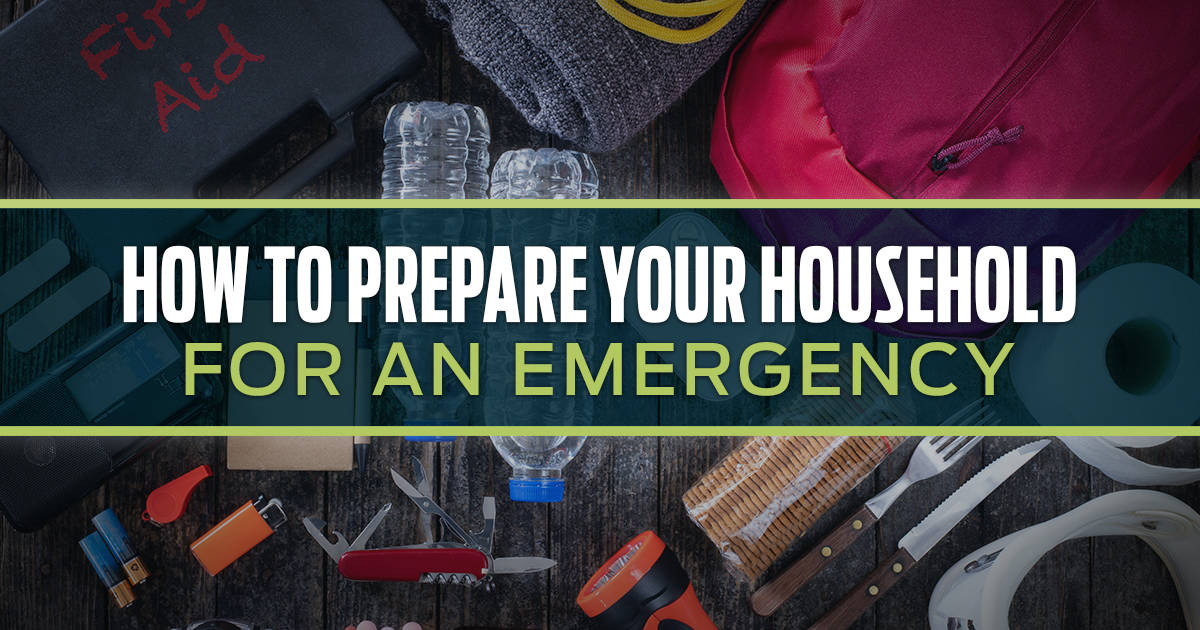
Emergency kits should be designed to sustain you and everyone in your home for up to 72 hours. It should include essentials and be portable enough to potentially be carried outside of your home, should you need to evacuate. Here is a list of what it should include:
- Non-perishable food. This means canned food, energy bars/protein bars, dried nuts and fruit, powdered food, etc. You’ll want to replace this food once per year. Even though it’s unlikely to spoil, it’s better to be safe than sorry. Make sure you include a can opener and utensils.
- First aid kit. A basic first-aid kit with gauze, band-aids, sterile wipes, scissors, etc. should be included among your essentials in case there’s an injury or accident.
- Water. Include enough bottled water to sustain each member of your household with around two liters of water per day. Avoid larger gallons as they’re more difficult to carry.
- Flashlights with additional batteries. If there’s an outage, you’ll need a way to see through the dark. You may also want to include candles with matches or a lighter.
- Sleeping bags and blankets. In case you need to stay in your house without power for a prolonged period, include warm blankets and sleeping bags for each member of your household.
- Radio. If something serious goes on in your area, this can help you stay in the loop.
- Additional house keys and car keys. This can save you from scrounging around your home for your keys if something happens – or if they’re inaccessible. You should also pack a small amount of change.
- Prescription medicine or formula if you can’t go to a grocery store/pharmacy.
- Hygiene products, such as hand sanitizer, toilet paper, tissue paper, toothbrush, and toothpaste in case you run out.
- Extra clothing, in case you have to leave your home very suddenly and require an additional change of clothes.
- Important documents, including important contact info, with phone numbers, addresses, and names for out-of-town contacts. Include the contact info of your family doctor. You should also include copies of your auto and home policies, in case you need to submit a claim, as well as an inventory of your belongings to prove for your home’s contents insurance.
This kit should be placed somewhere that is easily accessible in the event of an emergency. Try not to put it too far out of the way or somewhere you’d forget it easily. Ideally, you’ll never have to use your emergency kit or even your emergency plan, but it’s always better to be safe than sorry.
And, finally, we highly recommend getting insured. Home insurance/renters’ insurance (whether you own or rent your home) can financially protect your investment if anything should ever happen.